
2025-12-27 / HIP 24379 / (255) Oppavia
| # | OBS | Observer | Occ | Meth. | Instr. | CC | TSRC | UT1 | UT2 | UT3 | UT4 | UT2E | UT3E | Dur. | Chrd |
|---|---|---|---|---|---|---|---|---|---|---|---|---|---|---|---|
| 1 | show | Fausto Delucchi | O+ | VIS | M150 | CH | ? | 21:48:00 | 21:48:38.28 | 21:48:43.48 | 21:49:00 | 0.500 | 0.500 | 5.20 | 58.2 |
| 2 | show | Alberto Ossola | O+ | VID | M230 | CH | GPS | 21:48:04 | 21:48:37.86 | 21:48:42.72 | 21:49:21 | 0.020 | 0.020 | 4.86 | 54.4 |
| 3 | show | Stefano Sposetti | O+ | VID | M200 | CH | GPS | 21:46:50 | 21:48:38.18 | 21:48:41.04 | 21:51:30 | 0.020 | 0.020 | 2.86 | 32.0 |
| 4 | show | Szabolcs Nyari | O+ | VIS | M90 | HU | ? | 21:45:20 | 21:47:26.2 | 21:47:31.6 | 21:47:50 | 0.200 | 0.200 | 5.40 | 60.5 |
| 5 | show | Andrea Manna | O- | VID | M200 | CH | GPS | 21:45:23 | :: | :: | 21:50:07 |
5 observations found in db: sodis
Available (probably) matching predictions (click on the link to switch):| JPL80 : 5f19b520-d999-11f1-43f3-e3c1fdd9d368 [db: observed] |
Using prediction 5f19b520-d999-11f1-43f3-e3c1fdd9d368 for map and profile fit
| Ellipse and circular profile fits to the timings (chords) |
|---|

|
Auto-Fit Result: Size = 68 x 31 km a',b' = 33.9, 15.5 km X0,Y0 = 113.4, 31.3 km Mean diameter = 46 km From 4 chords (VID,VIS) You can enter space separated chord numbers (example: 11 4 8) or a method like VIS to ignore all visual timings, or a time source like RAD and NTP (but not GPS). If the plot disappears, then there are less than 2 chords left (too much ignored, go back with browser). Check SiMDA for size and mass data. Check Johnston Archive for satellites. |
Sky projection (artificial light) for occ. time: 2025-12-27, 21:48 UT (JD = 2461037.408)
| DAMIT | Q | P (h) | λ, β | JD0 | JD-JD0 | φ0 | Version | Modified | Vol-equiv D | Cmnt |
|---|---|---|---|---|---|---|---|---|---|---|
| # 4939 | 1.0 | 19.497 | 134°, 46° | 2.45723e6 | 3807.4 | 0.0° | None | 2020-10-05 | not scaled | 2019-10-23 |
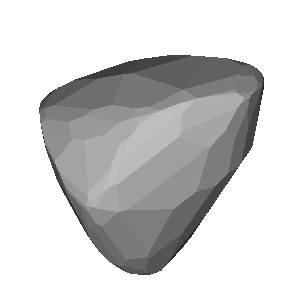
Image size: 300px. Transparent image background for copy & paste
| Map with groundtrack and observer stations |
|---|
| Event Details |
|---|
Occultation UUID [and DB] : 5f19b520-d999-11f1-43f3-e3c1fdd9d368 [observed] Occultation Date + Time : 2025-12-27 at 21:48:10 UT +/- 0.01 min [1] Object Designation : (255) Oppavia Orbit Class : MBA Star Designation : GDR3 0187220240072120192 Star Coordinates (ICRF) : RA = 05 13 49.2626, DE = +37 01 56.676 [2] Star Magnitudes : G = 6.86 mag, RP = 6.84 mag, BP = 6.85 mag Object Magnitude : V = 14.43 mag Estimated Magnitude Drop : 7.6 mag Estimated Max. Duration : 5.1 sec Object Mean Diameter : 57.4 km (src: astorb) Speed of the shadow : 11.2 km/s Elongation to Moon & Sun : 73° (sunlit = 51%), Sun = 159° Cross-track uncertainty : 0.8 mas = 1 km = 0.02 path-width (1-sig) RUWE and duplicate source : 0.9 mas, dup.src = 1 (0:false, 1:true) Ephemeris Reference : JPL80 Note : FP:true [1] time t0 of closest geocentric approach c/a, [2] including proper motion until t0 |
| More Data and Informations |
|---|
(If error 404: link not valid which means no data available)
| Aladin Sky Atlas |
|---|
Loading sky atlas…
|
| Aladin Lite direct link (has Gaia overlay) |